


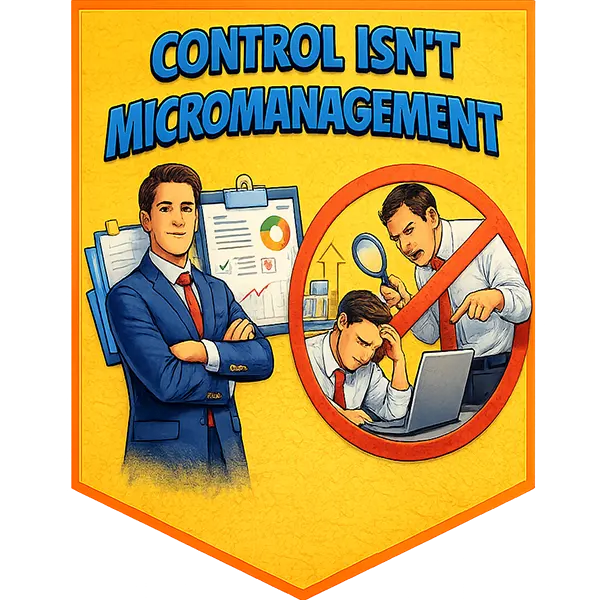
Here’s something I’ve noticed after working with dozens of remote teams: most founders get control completely backward.
They think control means knowing what everyone is doing at every moment. So they set up activity trackers, schedule endless check-ins, and basically try to recreate the office environment online. And honestly? I get it. When you can’t physically see your team working, there’s this nagging feeling that maybe things are slipping through the cracks.
But here’s the thing, that approach doesn’t just fail to create control. It actively works against you. Your execution slows down, your team gets frustrated, and the results become more inconsistent, not less.
Real control in a remote setting? It has nothing to do with watching people work. It’s all about building systems that make the work happen predictably, whether you’re looking or not.
Why Traditional Oversight Completely Backfires With Remote Teams
Let’s be real for a second. When your team is remote, you literally cannot see every action they take. And honestly, you shouldn’t want to.
I’ve watched plenty of leaders try to compensate for the lack of physical presence by ramping up digital surveillance. More Slack messages. More “quick sync” calls. More status update requests. They think this recreates the visibility they had when everyone sat in the same office.
What actually happens? You create a mountain of noise that buries the signal. Everyone—including you—ends up drowning in decision fatigue. Your team spends more time reporting on work than actually doing it.
Here’s what oversight without proper structure inevitably creates:
Endless clarification loops. Without clear documentation and processes, people keep asking the same questions over and over. “Wait, how did we decide to handle this again?” becomes a daily refrain.
Approval bottlenecks everywhere. When people don’t have clear authority boundaries, every decision needs to flow through you. Your inbox becomes a graveyard of progress, with dozens of tasks waiting for your green light.
Zero sense of ownership. If someone’s always watching and directing, why would team members take initiative? They learn to wait for instructions instead of thinking critically about what needs to happen next.
Mutual burnout. You’re exhausted from all the managing. They’re exhausted from all the managing. Nobody’s happy, and the work still isn’t getting done efficiently.
I’ve seen teams where the founder was working 70-hour weeks “managing” people who were perfectly capable—they just didn’t have the right framework to operate independently.
What Real Control Actually Looks Like in Practice
The remote teams that actually perform at a high level? They’re not the ones with the most oversight. They’re the ones with the clearest systems.
True control isn’t about supervision. It’s about creating an environment where the right things happen naturally because the structure makes it obvious what “right” looks like.
Let me break down what that actually means in practice:
1. Clearly Defined Roles and Responsibilities—And I Mean Really Clear
This sounds basic, but most teams get it wrong. They think role clarity means having job titles and vague descriptions like “responsible for marketing” or “handles customer success.”
That’s not clear enough for remote work.
Each person on your team should be able to answer these questions without hesitation:
- What specific outcomes am I responsible for? Not “marketing” but “generating 50 qualified leads per month through content and paid channels.”
- Where exactly do my responsibilities start and end? If something breaks, is it my problem to fix, or do I hand it off? At what point does my work become someone else’s input?
- How does my role connect to everyone else’s? Who depends on my work? Whose work do I depend on? What happens if I drop the ball?
When roles overlap or have gaps, remote teams fall apart fast. You can’t just walk over to someone’s desk and sort out who’s handling what. The confusion compounds silently until something breaks.
I’m talking about documentation here. Written role definitions that people can reference. Not buried in some forgotten Google Doc, but actively used and updated as the business evolves.
2. Ownership of Outcomes, Not Just Task Completion
Here’s a pattern I see constantly: founders assign tasks instead of outcomes.
“Update the website copy.” “Send the client proposal.” “Post on social media three times this week.”
Those are tasks. And sure, someone can check them off a list. But checking off tasks doesn’t necessarily move your business forward.
Outcomes are different. Outcomes are the actual results you need.
Instead of “update the website copy,” it’s “improve homepage conversion rate by 15% through clearer value proposition and stronger CTAs.”
See the difference? One is just doing the thing. The other requires thinking about what actually matters and using judgment to get there.
When people own outcomes, they start behaving differently. They don’t just execute what you tell them—they think about the best path to the result. They spot problems earlier. They suggest improvements you wouldn’t have thought of. They don’t sit around waiting to be told what to do next because they can see what needs to happen to hit their outcome.
This is especially critical for remote teams because you can’t be in every conversation, every decision, every moment. You need people who can think independently and take ownership of making things work.
3. Structured Check-Ins and Feedback Loops—Not Constant Interruption
Let me clear something up: structured communication is not the same as constant communication.
Constantly pinging people, having random check-ins whenever you feel uncertain, asking for updates throughout the day—that’s not control. That’s chaos dressed up as management.
Real control comes from predictable, scheduled communication that everyone can plan around.
Here’s what that looks like:
Regular review cadences. Maybe it’s a weekly team sync. Maybe it’s biweekly one-on-ones. Maybe it’s a monthly strategic review. Whatever the frequency, it should be consistent and expected. People know when they’ll have your attention and when they need to have updates ready.
Clear performance metrics everyone can see. Not hidden in your head or some private spreadsheet. Public dashboards or shared reports that show how things are tracking. When metrics are visible, people self-correct before you even need to ask questions.
Consistent feedback that’s actually helpful. Not just “good job” or “this needs work,” but specific observations about what’s working and what isn’t. And crucially, it happens on a schedule, not randomly when something goes wrong.
This structure creates alignment without you needing to hover. People know what’s expected, when they’ll get feedback, and how they’re being measured. The predictability itself builds trust and reduces anxiety on both sides.
4. Agreed Standards for Quality and Deadlines—Nothing Left to Assumption
You know what kills remote teams? Implied expectations.
“I need this to be high quality.” Okay, but what does that mean? High quality to you might be completely different from high quality to someone else on your team.
“Get this done as soon as possible.” Is that today? This week? Before the end of the quarter? Everyone interprets urgency differently.
When you’re remote, you can’t rely on picking up context clues from office conversations or reading someone’s body language to understand what’s really important. Everything needs to be explicit.
Quality standards should be documented. What does “done” look like for different types of work? What level of polish is required before something ships? What are the non-negotiables versus the nice-to-haves?
Deadlines should be specific and include context. Not “ASAP” but “by end of day Thursday because the client presentation is Friday morning.” When people understand why the deadline matters, they prioritize them differently.
Here’s what happens when you get this right:
- Decisions happen faster because people aren’t second-guessing whether their judgment aligns with yours.
- Rework drops dramatically because people nail it the first time instead of discovering your unspoken expectations after they’ve already done the work wrong.
- Trust increases on both sides—you trust they’ll deliver what you actually need, and they trust that you’re not going to move the goalposts after they’ve already done the work.
The Bottom Line: Control Is a System, Not Supervision
Once you have these elements in place—clear roles, outcome ownership, structured communication, and explicit standards—something almost magical happens.
Work gets done correctly even when you’re not paying attention. Your team doesn’t need constant direction because they already know what good looks like and how to get there.
Without these systems, all the check-ins in the world won’t prevent mistakes or delays. They’ll just mask the deeper structural problems while slowing everything down.
Think about it this way: supervision is you trying to be the system. You’re the one catching problems, making decisions, providing direction, filling in gaps. That doesn’t scale. Eventually, you become the bottleneck.
But when you build actual systems—documented processes, clear ownership, predictable rhythms, explicit standards—the structure does the work. You shift from being the person who makes everything happen to being the person who built the environment where everything happens naturally.
How High-Performing Remote Teams Actually Operate
The best remote teams I’ve seen share some common characteristics:
Success is defined clearly and upfront. Everyone knows what winning looks like, not just for the company but for their specific role. There’s no ambiguity about what matters most.
Accountability is explicit and visible. It’s not buried in someone’s head or documented in a place nobody checks. People know what they own, and everyone else knows it too. This creates healthy pressure and eliminates finger-pointing when something goes wrong.
Systems replace guesswork. Instead of people constantly asking “how should I handle this?” or “what would you do here?”, the answer is usually in a documented process, a clear standard, or an established precedent. The system provides the answer so you don’t have to.
These teams move fast because they’re not waiting on you for every little thing. They make good decisions because they have clear frameworks to operate within. And they consistently deliver quality work because everyone agrees on what quality means.
A Quick Self-Assessment
Take a minute and honestly answer this question:
Do your remote team members have clear ownership of specific outcomes with measurable success criteria—or are you relying on frequent oversight and check-ins to feel like things are under control?
If your answer is the second one, I want you to understand something important: the problem isn’t your team. It’s not that you hired the wrong people or that they’re not motivated or capable enough. The problem is the system—or more accurately, the lack of one.
No amount of talented people can overcome a structural problem. If your team doesn’t know exactly what they own, what success looks like, what standards to hit, and when they’ll get feedback, even the best performers will struggle and underdeliver.
The good news? This is fixable. It doesn’t require replacing your team or working longer hours to manage them more closely. It requires stepping back and building the systems that make control automatic instead of manual.
Start with one element. Pick the area that feels most chaotic right now. Is it unclear who owns what? Start documenting roles. Is quality inconsistent? Define your standards. Are people constantly waiting on you for decisions? Map out clear ownership of outcomes and decision-making authority.
You don’t need to overhaul everything overnight. But you do need to start building the structure that lets your remote team perform at the level you know they’re capable of.
Because real control? It’s not about watching harder. It’s about building better.